


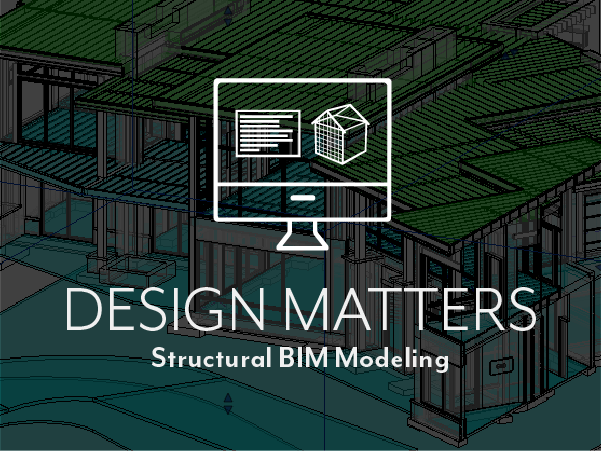
Design Matters: Structural BIM Modeling
Design Matters: Structural BIM Modeling
At FOCUS, the shift toward 3D modeling has changed more than just how drawings are produced. It has reshaped how teams communicate, coordinate, and understand a building long before it is constructed.
For Scott Dawes, a CAD designer at FOCUS, that shift is as much about visibility as it is about workflow. “It’s honestly pretty fun to see how buildings come together in the 3D model,” he explains. Glen Pool, a structural designer at FOCUS, notes that it also creates a better way to collaborate: “It really helps us all stay on the same page.” The model becomes a shared environment where decisions are less isolated between disciplines. Scott and Glen help explain how these tools create an opportunity for designers to provide better service.
Working in a Shared Model
In practice, projects still begin with architectural input, but structural work is developed directly within a coordinated 3D environment. Even when 2D plans are produced at the end, the real coordination happens in the model. As Glen describes, “We’re providing two-dimensional plans, but we’re modeling it in 3D so that we can see more.” That added dimension allows teams to identify conflicts early and stay aligned as changes occur. Glen adds that the biggest advantage is clarity across disciplines. “It helps to see structural clashes with what’s going on architecturally.” Instead of discovering conflicts during construction, teams can resolve them in the office.
Scott explains how automated systems highlight these issues: “If there’s a clash between mechanical and framing, the clash detection functionality in the software will immediately identify that for them.” What once required extra time to perform manual checks can now be flagged in real time. Even outside of automated tools, the model itself can reveal problems that might be visually overlooked otherwise.
Communication is Key
While this technology improves coordination, it’s still supported by communication across teams. Glen points out that even small architectural changes can have major structural impacts. He shares, “These projects are fast-moving, so it’s possible that a change as small as moving a wall four inches could be overlooked.” Because the model is interconnected, updates need to be communicated clearly and consistently. When they are, changes appear almost immediately. Scott adds, “If they make any changes, we see those immediately as soon as they synchronize.”
Modeling takes longer than traditional drafting, particularly compared to AutoCAD workflows. For fast-moving residential projects, that time difference can still be a deciding factor. Even so, the increased precision often justifies the investment. As Glen puts it, “I think the pros outweigh the cons most of time,” especially when early coordination prevents larger issues later. Scott shares, “It takes more time to draft, but it really helps with the unique, complex parts. On a recent project with multiple flat roof levels and split floors across different slopes, 2D drafting in AutoCAD would have been faster. However, doing it in Revit allowed us to see all the unique interactions between the framing elements and make sure everything was correct.”
Modeling the Future
Both Scott and Glen see modeling technologies evolving and becoming more central to project delivery, particularly in commercial work where timelines and coordination already support it. Scott believes the direction is clear. “I think that it’s going to be used way more,” he says, pointing to broader adoption across project types over time. Looking further ahead, Glen sees deeper integration between modeling and design itself. “I could see this eventually becoming part of 3D models,” he explains, where engineers review what the model is doing and focus on designing the more complex areas, while allowing the model to handle many of the more mundane tasks. He points to a future where engineers could input a location and the model would understand the loads involved and design accordingly, signaling a shift toward increasing automation of repetitive structural work.
For both designers, the value of modeling comes down to clarity. It reduces uncertainty, improves coordination, and allows teams to see problems before they become expensive. As Scott puts it, “You can be way more precise in BIM and you can see the changes immediately.” That immediacy is what ultimately defines the shift. Not just better drawings, but a better shared understanding of the building itself.
To partner with FOCUS Consulting, contact our team at info@focus-es.com or (801) 352-0075.
