


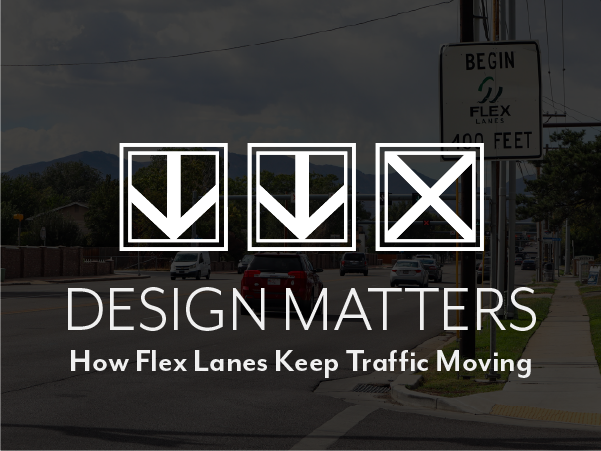
Design Matters: How Flex Lanes Keep Traffic Moving
Design Matters: How Flex Lanes Keep Traffic Moving
We sat down with Jason Watson, project manager in the FOCUS Transportation Department, to learn how flex lanes help roads handle the changing direction of traffic. On a typical five-lane road, two lanes travel in each direction, while the center lane is used for left turns. During peak traffic hours, that center lane can serve a different purpose. “What they’ll do during those peak rush hour times is they’ll actually turn that center lane into an additional third through lane in that direction,” Jason explained. When traffic heads the other way later in the day, the lane can switch directions. During quieter hours, it returns to a two-way left-turn lane.
Making More of the Road We Have
The advantage is that a road can carry more traffic when it needs to without adding another lane to its full width. “You don’t necessarily have to go in and widen an existing road,” Jason said. That can make flex lanes especially useful where homes or businesses sit close to the roadway and there is limited space to expand. When crews install flex lanes, they must change the road striping and add overhead signals that show which lanes are open in each direction. Jason noted that this process can be quicker and less costly than rebuilding and widening the road. The approach works best when traffic is heavy in one direction in the morning and the opposite direction later in the day. If both directions are equally busy, switching a lane would offer less benefit. Jason pointed out an existing flex lane on 5300 South as a long-standing Utah example of a flex lane in use. Drivers also play an important role. Green arrows above the road show when a lane is open, while a red X means drivers must stay out of that lane. Because the center lane’s use changes throughout the day, paying attention to those signals is essential. “It’s very clear when you’re on it,” Jason said, “but if you’re not paying attention, you could cause some pretty serious accidents.” For Jason, flex lanes are a good option for roads that need more capacity at certain times of day. By matching the available lanes to the direction people are traveling, engineers can improve traffic flow within the space a roadway already has.
Why Aren’t Flex Lanes Everywhere?
Although flex lanes may be unfamiliar to many drivers, Jason said the idea has been around for years. “I don’t think it’s necessarily a new thing,” he said, pointing to the flex lanes on 5300 South. What matters more is whether a road has enough traffic moving in opposite directions at different times of day to make switching a lane useful. That pattern is why Jason brought up Pioneer Crossing. With heavy traffic heading toward the Salt Lake area in the morning and back toward Saratoga Springs in the afternoon, a flex lane can help address congestion while other plans for the corridor move forward. “It’s a quick solution that can come in and help,” he said. Flex lanes won’t be the right fit for every road, but where rush hour traffic changes direction, they can make better use of the space already available. As corridors like Pioneer Crossing grow, that flexibility can help keep people moving while longer-term improvements take shape.
To partner with FOCUS Consulting, contact our team at info@focus-es.com or (801) 352-0075.
